To provide the best experience on IzziGo, we use cookies and similar technologies to store and/or access device information. This allows us to improve website functionality, personalize content and recommendations, analyze usage and performance.
We updated our privacy and cookie settings. Please review your choices again.
Analytical, preference, marketing, and external media services require your consent.
You can change or withdraw your consent anytime.
✓
Privacy and cookie settings
Choose which optional technologies IzziGo may use.
Your control
We updated our privacy and cookie settings. Please review and confirm your choices again.
Your privacy choices
Necessary and security technologies keep IzziGo working safely. All other categories are optional and remain blocked unless you allow them.
Open a category to review its purpose and change the setting. You can return here at any time to update or withdraw your consent.
Along the western edge of Mykonos Town, Little Venice is known for old houses and balconies set directly above the Aegean. The waterfront is especially atmospheric in the late afternoon, when sea views and changing light draw walkers toward the narrow lanes nearby. It is an easy place to experience the town’s relationship with the water while exploring on foot, with the famous windmills visible just beyond the shoreline.
Panagia Paraportiani is one of Mykonos Town’s most recognizable religious landmarks, a whitewashed church complex near the historic Kastro area. Its asymmetrical forms, rounded surfaces and bright Cycladic walls make it striking from several angles rather than from a single formal façade. Visitors can appreciate it as part of the town’s layered streetscape, where small chapels, homes and lanes sit closely together near the old waterfront.
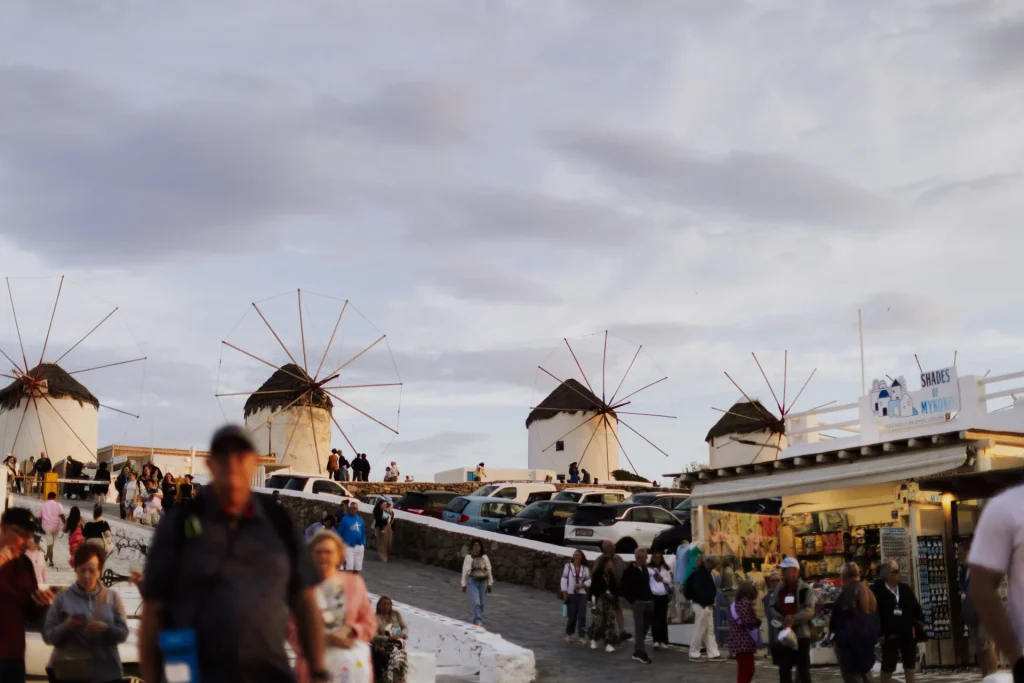
The Kato Mili windmills stand on a low ridge beside Mykonos Town, overlooking the sea and Little Venice. Their compact white forms and wooden sails reflect the island’s historic use of wind power for milling grain. Today, the group is one of the town’s clearest visual landmarks and a natural stop on a walking route through Chora. The open setting also gives travelers broad views toward the waterfront and surrounding Cycladic buildings.
Matogianni Street is one of the best-known pedestrian routes through central Mykonos Town, threading between whitewashed buildings, small shops, cafés and side lanes. Rather than treating it only as a shopping street, explore it slowly and turn into the narrower alleys that branch away from the main flow. The changing mix of shaded passages, small squares and painted details offers a useful sense of how compact and walkable the historic center feels.
Kopanisti Mykonou is a traditional Cycladic cheese associated with Mykonos and neighboring islands, known for its soft texture and distinctly sharp, peppery character. In Mykonos Town, travelers may encounter it in local dishes or simple meze-style preparations. Its strong flavor makes it a memorable taste of the island’s food culture, especially when sampled alongside bread, tomatoes or other straightforward ingredients that let the cheese remain the focus.
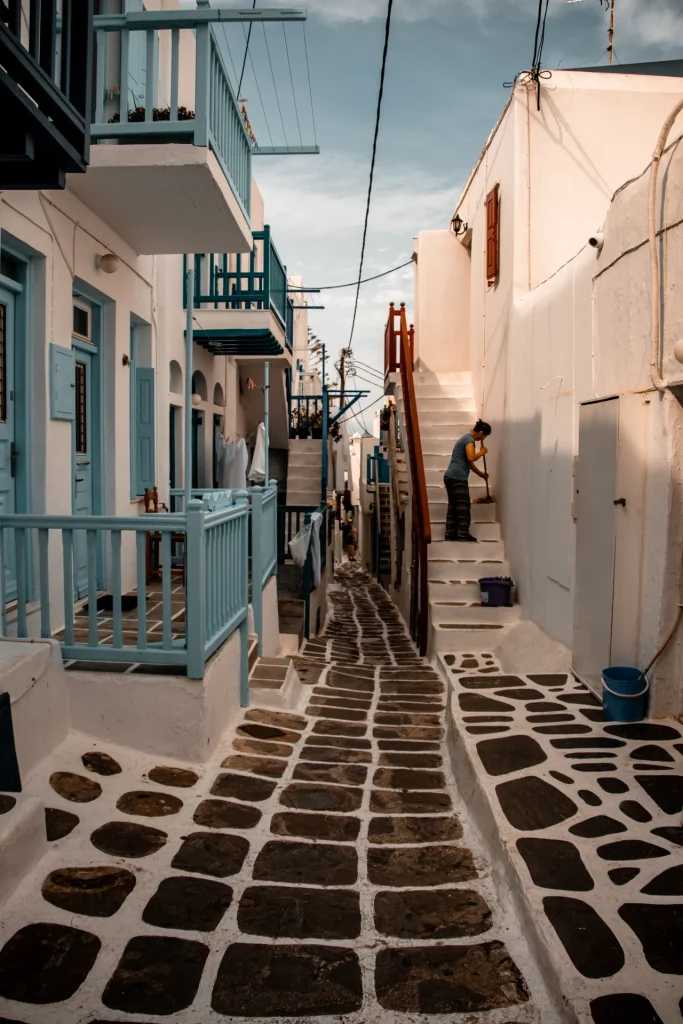
Mykonos Town, also known as Chora, is the island’s main settlement and one of the most recognizable urban landscapes in the Cyclades. Its maze of whitewashed lanes, small squares, churches, shops and waterfront views creates a setting made for slow exploration. The town can be lively, especially in summer, but early walks and quieter corners still reveal local details, traditional architecture and the strong relationship between island life and the Aegean Sea.
City culture
Stories from Mykonos Town
Local identity, everyday culture, food, neighborhoods and traditions through IzziGo editorial stories.